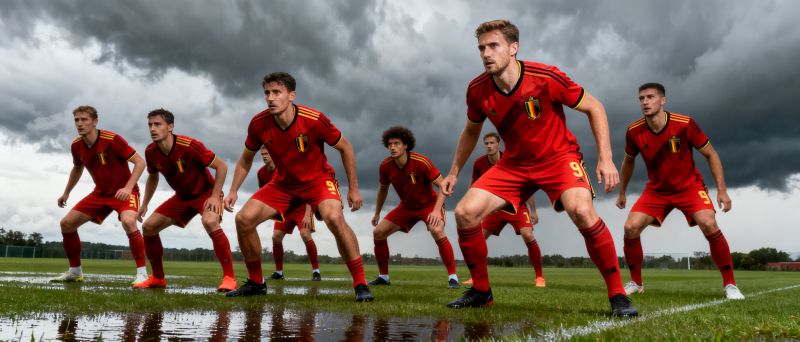
he Belgian squad for Euro 2016 landed with a thud of inevitability rather than a gasp of surprise. Marc Wilmots named 23 players on May 12, and the list read like a who’s who of the Premier League’s upper crust: Eden Hazard, Kevin De Bruyne, Romelu Lukaku, Thibaut Courtois. That Belgium’s Euro 2016 squad announced such star power was never in doubt. The questions, as ever with this group, hovered around balance and backbone. Wilmots leaned heavily on the names that had dragged Belgium to the top of the FIFA rankings。but the omission of Radja Nainggolan—then at his combative best for Roma—raised eyebrows from Brussels to Bergamo. Nainggolan’s exclusion felt less like a tactical choice and more like a manager avoiding a personality he couldn’t control. Wilmots insisted he preferred “pure ball-players” in the engine room. Fine. But against Italy’s midfield in the opener, that purity would be tested by grit.
Goalkeeping and defence picked themselves. Courtois。despite a patchy season at Chelsea, remained untouchable. Simon Mignolet and Jean-François Gillet provided adequate cover. The back four, though, carried genuine intrigue. Toby Alderweireld’s Tottenham form made him the first name on the sheet. Thomas Vermaelen’s fitness was a riddle wrapped in a Barcelona medical report—he’d played barely a handful of minutes all season. Wilmots still took him. Jan Vertonghen shifted to left-back more often than not, sacrificing his central partnership with Alderweireld. That tactical reshuffle exposed a nagging truth: Belgium’s defensive depth was thinner than a waffle. Jason Denayer, raw and loaned out to Galatasaray, was the only genuine centre-back cover. One injury to Alderweireld or Vermaelen and the whole structure wobbled.The midfield offered Wilmots his most delicious headache. Axel Witsel and Marouane Fellaini—tall, physical, occasionally ponderous—formed the axis. Mousa Dembélé, coming off an outstanding season at Spurs, deserved more than a cameo role but often found himself shunted wide. Yannick Carrasco, then a rising force at Atlético Madrid, added directness. The real flourish, though, was the inclusion of 19-year-old Youri Tielemans?No。Tielemans missed out. Instead, Wilmots gambled on Christian Kabasele as defensive cover and handed a spot to Jordan Lukaku, Romelu’s younger brother, as a left-wing-back option. That call felt sentimental. Jordan was quick but defensively naive. Against top-tier wingers, his rawness could be a liability. Wilmots’s Belgium’s Euro 2016 squad announced a clear preference for attacking verve over pragmatic shielding.Up front。the riches were almost embarrassing. Lukaku, fresh from a 25-goal season at Everton, led the line. Hazard and De Bruyne floated behind him, with Dries Mertens and Divock Origi as game-changing substitutes. Michy Batshuayi, then a hot property at Marseille, barely got a look-in. That abundance masked a structural flaw: Belgium’s forwards often operated as isolated islands. Wilmots’s attacking plan, if one existed, relied on moments of individual brilliance rather than cohesive patterns. It worked against Hungary in the round of 16, a 4-0 stroll. Against Wales in the quarter-final, it crumbled. Hazard cut a frustrated figure on the left;
De Bruyne drifted centrally into traffic. No one pulled the strings. The absence of a genuine deep-lying playmaker—someone like Nainggolan, ironically—left Belgium’s build-up predictable.Belgium’s Euro 2016 squad announced a collection of individual talents that never quite cohered. Wilmots’s team reached the quarter-finals, but the 3-1 defeat to Wales exposed the gap between reputation and reality. The defence was patched up, the midfield lacked a destroyer, and the attack too often waited for magic. Looking back, that summer in France marked the end of Wilmots’s tenure and the beginning of a quieter。more structured era under Roberto Martínez. The golden generation had its moments—Hazard’s solo goal against Hungary was a peach—but the squad announcement itself now reads like a warning sign. Too many artists, not enough soldiers. Belgium would learn that lesson the hard way, one Welsh counter-attack at a time.